

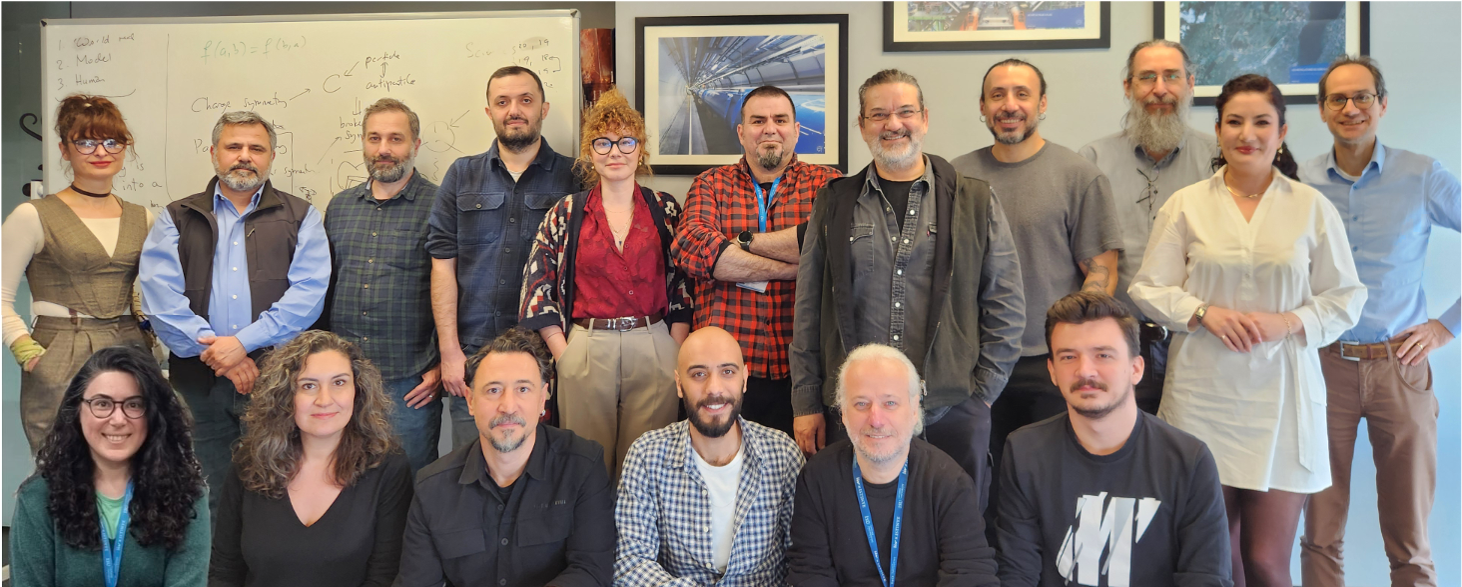
The competent academic and technical staff the HEPP Research Group are involved in advanced studies on High Energy Physics, Particle Physics, Particle Detectors and Particle Accelerators.
The local laboratory infrastructure to conduct R&D in these fields together with various externally funded projects (TÜBİTAK, TENMAK, TÜSEB) and memberships in world-class international research collaborations offer unique opportunities to PhD students as well.
Istinye University is a member of five (ATLAS, CAST, DRD1, DRD Calo, FCC) collaborations at CERN, the European Particle Physics Laboratory, one (BESIII) experiment at the Institute of High Energy Physics of the Chinese Academy of Sciences, and one (sr-EDM) experiment under preparation at the US Brookhaven National Laboratory as well as the COST action CosmicWISPers.


 .
. 



Measurement of the Average Magnetic Field in a Particle Accelerator Beamline Using the K-Modulation Method (2023-2026) / TÜBİTAK (1001)
Investigation of the Potential of Scintillation Powders and Optical Media for Cosmic Neutron Detection (2024-2027) / TÜBİTAK (1001)
MeV-Energy Electron Accelerator Design Software (2023-2026) / TÜBİTAK (1001)
Measurement of Cosmic Muon Flux in Antarctica and Investigation of the Effects of Solar Activity on Cosmic Muon Flux (2025-2027) / TÜBİTAK (Polar-1001)
Determination of Particle Positions Using Machine Learning with Epoxy Resin-Based Opaque Plastic Scintillator (2026-2028) / TÜBİTAK (1001)
Estimation of Eye and Surrounding Organ Doses in Eye Brachytherapy Using Monte Carlo Simulations, Machine Learning, and Dosimetry Applications (2026-2029) / TÜBİTAK (1001)
Ecological Improvement for Gases Used in Gas-Type Particle Detectors (2024-2025) / TÜBİTAK (1002)
Alignment of Quadrupole Magnets in Particle Accelerators with Machine Learning Support (2025-2026) / TÜBİTAK (1002)
Development of an Active Shielded Gamma Probe (2021-2023) / TÜBİTAK (1005)
Production and Characterization of Lithium Tetraborate Nanoparticle-Doped Plastic Scintillators (2024-2026) / TÜBİTAK (1005)
Design and Development of a Local DAQ and DCS System with IoT Integration (2025-2026) / TÜBİTAK (1005)
Production of a Novel Cosmic Ray Neutron Sensor for Measuring Soil Moisture over Large Areas (2022-2023) / TÜBİTAK (1512)
A step into the next frontier: Transforming trigger technology for new physics searches (2026-2029) / TÜBİTAK (2232A)
Geometric and Thermodynamic Analysis of Magnetically Charged Black Holes in Symmergent Gravity (2026-2028) / TÜBİTAK (2515)
Development of a Next-Generation Hybrid Gamma Probe through the Integration of Counting and Emission Direction Detection Functions (2024-2026) / TÜSEB (B)
Development of a Unilateral Nuclear Magnetic Resonance Device for Measuring Dental Pulp Health (2026-2028) / TÜSEB (B)
Data Taking, Data Analysis, and Detector System Operation, Maintenance, and Upgrade Studies in the CERN-ATLAS Experiment (2021-2024; 2025-2028) / TENMAK (CERN)
Virtual Physics Laboratory Applications (Anadolu U.; 2024-2026) / Erasmus+ KA220-SCH
Cosmic WISPers in the Dark Universe (Bari U., Italy; 2022-2026) / COST Action CA21106
Development of a Portable Next Generation Medical Imaging System (Niğde Ömer Halis Demir U.; 2021-2025) / TÜBİTAK (1001)
Development of Neutron Interaction Model with Gadolinium Doped Water Cherenkov Detector (Erciyes U.; 2022-2025) / TÜBİTAK (1001)
Customized Scintillator Production for Particle Accelerators and Detectors (Boğaziçi U.; 2022-2024) / TÜBİTAK (1005)
Development of a polymer-based fiber optic sensor system for ulcer detection (Karamanoğlu Mehmetbey U.; 2025-2027) / TÜSEB (B)
Jet Physics Analysis and HCAL-HGCAL Detector R&D at CERN's CMS Experiment (Yıldız Technical U.; 2024-2027) / TENMAK (CERN)